AI memory stocks deserve investor attention because the demand signal is real: artificial intelligence servers need far more high-performance memory than ordinary computing systems. The mistake is treating that demand as a complete investment case. Micron Technology and SK Hynix both sit in the AI infrastructure supply chain, but they do not offer the same mix of market position, valuation, customer exposure, and cycle risk. Scarcity can lift profits quickly in memory. It can also tempt investors to pay as if scarcity lasts forever.
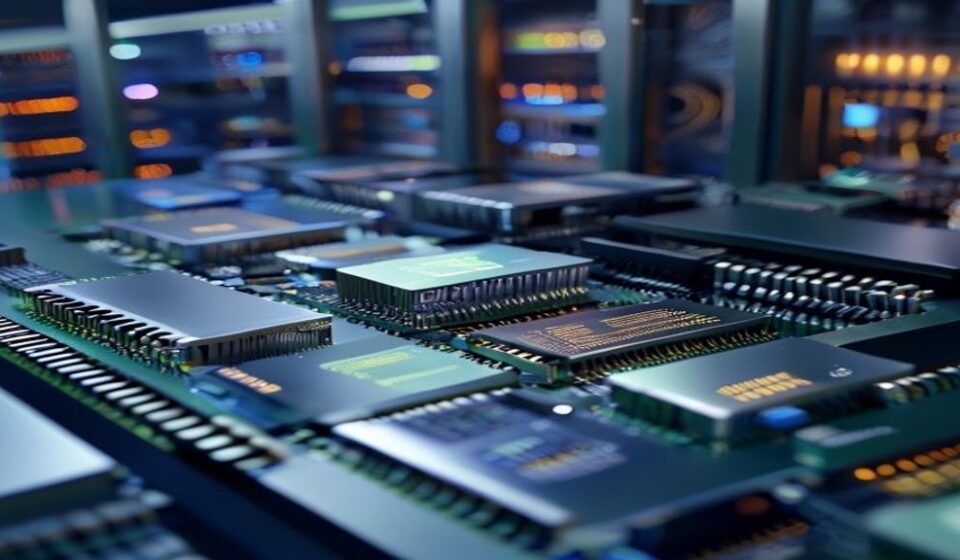
The current excitement centers on high-bandwidth memory, or HBM. HBM stacks memory chips vertically and places them close to advanced processors, allowing AI accelerators to move enormous amounts of data quickly. That matters because a powerful AI chip can be bottlenecked if it cannot get data fast enough. In plain English, HBM is not a decorative component in an AI server. It is part of the machinery that lets expensive GPUs earn their keep.
That is why memory makers have moved from the background of the AI trade to the foreground. A Motley Fool article on Micron described a severe memory-chip supply shortage tied to AI infrastructure demand and said Micron’s share price had risen nearly 700% over the prior year. Another Motley Fool summary on SK Hynix described SK Hynix as supplying 56% of the world’s AI memory chips. Those are secondary-source figures, not company filing data in the provided source set, but they capture the market’s central argument: AI demand has made memory strategically important again.
📊 AI memory stocks under the same spotlight
| Company | AI memory angle | Market position cited | Valuation point cited | Main investor question |
|---|---|---|---|---|
| Micron Technology | Beneficiary of AI-driven memory shortage | Not specified in provided summaries | Motley Fool cited forward P/E near 6 versus SK Hynix near 10 | How much of the shortage is already priced in? |
| SK Hynix | Leader in HBM and AI memory supply | Motley Fool cited 56% of AI memory chips; 24/7 Wall St. cited 58% of global HBM revenue | Motley Fool cited forward P/E near 10 | Does leadership justify a richer multiple? |
The table shows the real comparison. Micron appears cheaper on the one valuation metric cited in the summaries. SK Hynix appears stronger on the one market-share metric cited in the summaries. Neither fact settles the question. A lower multiple can reflect underappreciated upside, but it can also reflect weaker positioning or more volatile earnings. A higher multiple can reflect genuine leadership, but it can also leave less room for disappointment.
HBM changed the pecking order
For years, many investors treated memory as a brutally cyclical commodity business: attractive in upcycles, painful when supply caught demand. HBM complicates that old model. It is more specialized than standard DRAM, harder to qualify with major AI accelerator customers, and closely tied to advanced packaging and GPU road maps. That does not remove cyclicality, but it creates a premium layer inside the memory market.
SK Hynix’s advantage, as presented in the supplied summaries, is leadership in that premium layer. The Motley Fool summary says SK Hynix supplies 56% of the world’s AI memory chips. The 24/7 Wall St. summary separately says SK Hynix commands 58% of global HBM revenue. Because both are secondary-source claims, investors should verify them against primary materials or reputable market-research publications before using them as model inputs. Still, directionally, the point is clear: the market views SK Hynix as the HBM leader.
That leadership matters because AI server supply chains are not casual buyer-seller relationships. Large chip customers need qualified components, dependable production, and a road map that matches future accelerator designs. The Motley Fool summary says Nvidia signed a multiyear partnership with SK Hynix. If accurate, that kind of relationship is more valuable than a one-quarter sales bump. It can give a supplier visibility, technical feedback, and credibility with other customers.
Micron’s case is different. The provided Micron summary emphasizes shortage-driven growth, not dominant HBM share. That does not make Micron irrelevant; it means the thesis has a different center of gravity. Micron can benefit if AI infrastructure spending keeps pulling memory supply toward higher-value products and tightening broader DRAM availability. In a shortage, even the non-leader can see pricing power. The question is whether investors are paying for cyclical uplift, structural improvement, or both.
💰 Scarcity is powerful, then dangerous
Memory shortages can produce dramatic earnings moves because the industry has high fixed costs and pricing can swing quickly. When demand outruns supply, incremental price increases can flow through sharply. That is the seductive part of memory investing: operating leverage can make a company look transformed in a short period.
The dangerous part is that supply eventually responds. Producers add capacity, customers redesign procurement plans, and buyers who once feared shortage start managing inventory. Even HBM capacity is not infinite overnight, but the market will not ignore profit pools forever. For everyday investors, the key question is not whether AI memory demand is strong today. It is whether today’s stock price assumes a shortage that remains unusually favorable for too long.
The Micron article summarized in the source set gives a useful example of how quickly a reasonable theme can turn into a forecast-heavy story. It predicted Micron could reach $1,875 per share by late 2027, implying about 91% upside from a cited $982 share price, and assumed a late-2027 price-to-sales multiple of 8.5 times. That is not a company-reported figure; it is a secondary-source forecast. Its value here is not as a target to accept, but as a reminder that valuation assumptions can do a lot of the work in bullish AI narratives.
A multiple is not a fact about a business. It is the price investors agree to pay for a stream of uncertain future results. If future sales rise but the market assigns a lower multiple, a stock can disappoint even when the company grows. If margins peak with shortage conditions and then normalize, revenue growth alone may not protect investors. That is especially relevant in memory, where the historical pattern has been feast, investment, supply growth, and pricing pressure.
SK Hynix’s premium has a logic
The richer valuation cited for SK Hynix is not random. The Motley Fool summary says SK Hynix’s forward P/E edged up to 10 after its U.S. ADS debut, compared with Micron near 6. That comparison, while secondary-source and time-specific, fits the market-share story. Investors often pay more for the supplier with the strongest position in the highest-growth part of a market.
There is also a customer-concentration angle. The 24/7 Wall St. summary says the U.S. generated about 65% of SK Hynix’s revenue in Q1 2026 and that Nvidia contributed 24% of total 2025 sales. Those are not primary-source figures in the supplied material, so they should be treated as reported rather than filing-derived. If true, they cut both ways. Heavy exposure to the U.S. AI buildout can accelerate growth when demand is hot. It can also concentrate risk if one customer slows orders, changes technical requirements, or shifts allocation among suppliers.
That is the central trade-off in SK Hynix: leadership has value, but leadership tied to a narrow set of AI infrastructure customers can create a different kind of vulnerability. Investors sometimes treat customer quality as if it eliminates risk. It does not. A world-class buyer still negotiates hard, manages inventory, and changes product road maps when economics demand it.
Micron’s cheaper multiple needs an explanation
Micron’s lower cited forward P/E may look appealing beside SK Hynix’s higher one, but a cheaper multiple is only useful after asking why it exists. It may signal that investors are too cautious about Micron’s AI memory opportunity. It may also signal that the market sees Micron as less dominant in HBM, more exposed to standard memory cycles, or less certain in customer qualification.
The provided sources do not give enough primary data to decide that question. That limitation matters. An investor comparing Micron with SK Hynix should not stop at a P/E screen. The better work is to compare HBM capacity commitments, customer qualification status, gross margin trends, capital expenditure plans, and management commentary from official earnings materials. Without those inputs, the valuation gap is an observation, not a conclusion.
Still, Micron’s position in the debate is useful for disciplined investors. It shows that AI exposure is not a single category. Two companies can both benefit from the same infrastructure wave while deserving different multiples because their competitive positions differ. A company participating in a shortage is not the same thing as a company controlling the bottleneck.
⚠️ The hype risk hiding in plain sight
The phrase “AI memory stock” compresses too much. It can refer to HBM leadership, general DRAM pricing leverage, customer concentration, capacity discipline, or simply a stock chart that has already moved. Those are not interchangeable. Treating them as one theme is how investors end up buying a story instead of underwriting a business.
The clearest warning sign is when an argument moves from demand to price target without spending enough time on supply, margins, and valuation. AI server demand can be real, HBM can be scarce, and SK Hynix can be the leader, while the stock still carries risk if expectations are too high. Micron can be cheaper and still risky if its earnings power is more cyclical than the market currently wants to admit.
This is not a bearish case against AI infrastructure. It is a valuation case inside AI infrastructure. The distinction matters. A theme can be right and an entry price can still be demanding. Investors learned that lesson in prior technology cycles, and memory’s history makes the lesson sharper. Commodity-adjacent businesses rarely reward investors for ignoring the supply response.
How to read the next set of numbers
The next useful evidence will not be a louder headline about AI. It will be company-level data that shows whether HBM demand is translating into durable economics. For SK Hynix, the key evidence is whether reported HBM share remains high while customer concentration does not become a fragility. For Micron, the key evidence is whether AI memory growth lifts margins and mix enough to justify a narrowing valuation gap.
Investors should also watch the language around capacity. If management teams discuss tight supply, long-term agreements, and disciplined investment, that supports the scarcity thesis. If the conversation shifts toward rapid expansion, inventory normalization, or pricing concessions, the profit cycle may be moving into a less forgiving phase. Memory investors do not need to predict the exact turn. They do need to know what a turn would look like.
Valuation belongs in that same evidence file. The cited forward P/E gap, with SK Hynix around 10 and Micron around 6 in the Motley Fool summary, is only a snapshot. What matters is whether future earnings estimates are rising because volumes, pricing, and margins are improving together, or because analysts are extending peak conditions further into the future. The latter is where hype often enters through the side door.
🔑 A disciplined conclusion
Micron and SK Hynix are both credible AI infrastructure beneficiaries, but they are not interchangeable. SK Hynix appears, based on the provided secondary summaries, to have the stronger HBM leadership claim. Micron appears, based on the same source set, to carry the lower cited forward earnings multiple. That is the comparison investors should respect: leadership versus price, not excitement versus boredom.
The practical takeaway is simple and deliberately unglamorous. Do not buy AI memory stocks only because AI servers need memory. Ask how much demand is already in the valuation, how durable the company’s position is, and what happens if shortage conditions ease. In this part of the market, the story may be hot, but the math still has to cool it down.
This content is for general information only and is not a recommendation to buy or sell any security. Investment decisions are your responsibility.